On Saturday, February 28, 2026, President Donald Trump announced that the **United States military had begun what he described as “major combat operations” — a “massive and ongoing operation” — against the Islamic Republic of Iran. He delivered this message via a video posted on his social media platform, responding to what his administration characterized as imminent threats posed by Iran’s nuclear ambitions, missiles, and support for terror networks.
In his address, Trump opened by confirming that U.S. forces had begun a significant offensive against Iranian military targets, declaring that the objective was to defend the American people by eliminating immediate and serious threats from the Iranian regime. He described Iran’s leadership as a “vicious group of very hard, terrible people” whose actions endanger the United States, U.S. forces, U.S. bases overseas, and allied nations around the world.
He underscored the operation as a strategic extension of U.S. national security policy, explaining that for nearly five decades the Iranian regime has chanted “Death to America,” waged bloodshed, supported terrorism, and targeted American interests around the globe. Drawing on historical grievances, he cited Iran’s ties to attacks against Americans and others — including support for militant proxies — to justify the military campaign.
Regarding recent diplomatic efforts, Trump referenced nuclear deal talks that had taken place in Geneva between U.S. and Iranian negotiators. Though both sides conducted some of their most serious negotiations yet, the talks ultimately failed to yield an agreement that Trump viewed as adequate to halt Iran’s pursuit of nuclear capabilities. The president framed these failed negotiations as reinforcing the need for military action, asserting that Iran had repeatedly expressed interest in a deal only to back away or stall before meaningful concessions were made.
Crucially, Trump brought up internal developments in Iran, asserting that the regime had recently killed tens of thousands of its own citizens amid nationwide protests. According to Trump’s statement, these protests were sparked by economic conditions and political repression, resulting in what he described as mass casualties inflicted by Iranian authorities. (It’s important to note that independent verification of the specific figures Trump cited varies.)
This theme of Iranian domestic brutality fed into Trump’s rationale that Iran was not fit to be trusted with nuclear technology. He declared unequivocally that Iran “can never have a nuclear weapon,” repeating this phrase as a core tenet of U.S. policy. His administration claimed previous military operations — including “Operation Midnight Hammer,” carried out in June of the previous year — had obliterated key Iranian nuclear facilities such as Fordow, Natanz, and Esfahan. Trump argued that Iran’s refusal to abandon its nuclear ambitions justified escalated action.
As part of the military campaign, Trump outlined plans to destroy Iran’s missile capabilities, annihilate its navy, and dismantle the infrastructure used by Iranian-backed militant proxies across the Middle East. He stated that any remaining Iranian missile industries would be “totally obliterated,” and that terrorist groups destabilizing the region — often supported or armed by Tehran — would no longer threaten U.S. forces or allies.
While emphasizing U.S. military superiority — declaring that “there is no military on earth even close to its power, strength or sophistication” — Trump also acknowledged the real risks and potential American casualties associated with combat. He spoke directly to the possibility that “the lives of courageous American heroes may be lost” and that casualties could occur, noting that such sacrifices are sometimes part of military conflict but framing the effort as part of securing America’s future security and preventing a nuclear-armed Iran.
In a moment of solemn reflection, the president offered a prayer for U.S. troops, saying, “We pray for every service member as they selflessly risk their lives to ensure that Americans and our children will never be threatened by a nuclear-armed Iran.” He asked for divine protection over service members and expressed trust that “with his help, the men and women of the armed forces will prevail.” Trump concluded this portion by invoking blessings on the troops and on the United States, framing the mission as noble and just.
Turning his remarks toward Iranian military personnel — including members of the Islamic Revolutionary Guard Corps (IRGC), the armed forces, and police — Trump issued an ultimatum: lay down weapons and accept immunity, or face “certain death.” This stark warning was meant to encourage defections or minimize further bloodshed, according to the administration’s messaging. He then addressed the Iranian people themselves, asserting that “the hour of your freedom is at hand” and that they should stay sheltered, wait out the danger, and when the military phase is over, seize control of their government. He framed this as a historic opportunity for Iranians to shape their own future with U.S. support.
Trump also repeatedly called on Iran’s citizens to rise up against their leaders once the offensive eased, saying that “now you have a president who is giving you what you want.” He portrayed U.S. strength as backing the Iranian people’s aspirations for freedom and promised overwhelming support if they chose to overthrow their authoritarian leadership.
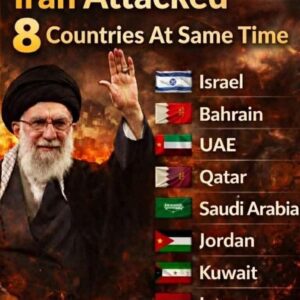
As violence unfolded — including reported Israeli airstrikes and retaliatory missile launches from Tehran — Trump’s message emphasized that this moment represented not only a tactical military operation but a broader geopolitical effort with potentially profound consequences for regional stability. The involvement of U.S. forces marked a major escalation in tensions between the U.S. and Iran, one that the administration is justifying as necessary to neutralize what it sees as existential threats.
In closing, Trump reaffirmed his belief that decisive action was the only viable means to prevent a future in which Iran had the capability to deliver nuclear weapons and threatened U.S. territory or interests. He ended with patriotic and religious sentiments, hoping that God would bless U.S. forces and the country through the conflict, signaling that the United States was prepared for a long and consequential campaign.